Population ageing has become one of the key demographic trends of the 21st century and is reshaping the design and delivery of housing for older adults. According to the United Nations, between 2015 and 2050, the share of the global population aged 60 and over is expected to almost double, rising from 12% to 22%. In 2020, the number of people aged 60+ exceeded the number of children under five.
This structural shift in society, in which a growing share of the population requires different levels of support, care, and living environments, gives rise to senior communities tailored to varying levels of independence and daily needs, as the sector extends far beyond traditional nursing homes and evolves into a broader system of living formats.
In practice, this raises very concrete questions about how to create a functional, safe, and comfortable environment for everyday use, which is typically explored using early spatial tools that show how a building works as a complete environment, with 3D floor plans being one of the most effective.
Further in the article, we explore how 3D floor plans for assisted living facilities support the design and communication of senior living spaces, and what needs to be considered when working with them in this type of environment.

Assisted Living 3D Floor Plans for Clearer Decisions
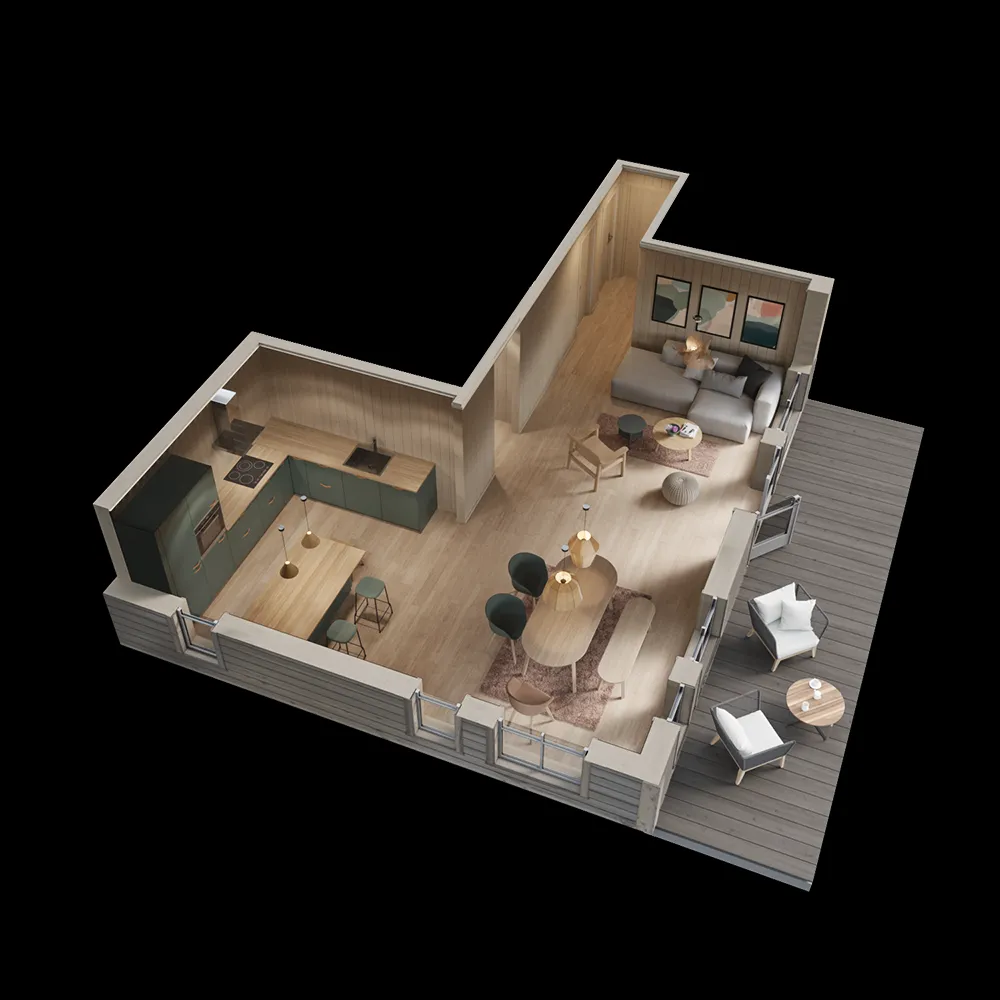
To start, let’s clarify what 3D floor plans for assisted living facilities are. It is an elevated visual representation of an architectural layout that combines the accuracy of a traditional floor plan with depth, scale, and basic spatial context such as walls, openings, furniture, and circulation paths. It is typically generated by converting architectural drawings into a simplified 3D model and presenting it from a fixed viewpoint for clear overall readability.
With this in mind, 3D floor plans provide a clear understanding of how spaces relate to each other within a single view, helping support more informed decisions around layout logic, circulation, and spatial organization in assisted living environments.
Accurate 3D Floor Plans for Assisted Living Facilities
Assisted living developments combine a range of spatial types, each with its own functional and environmental requirements, including living rooms, communal areas, an activity room, a kitchenette, an accessible bathroom, or a walk-in shower.
At the project design stage, it becomes essential to think through how each area functions on its own and how it contributes to the overall behavior of the environment, reinforcing an inviting atmosphere, safety, and comfort, while helping to form a clearer understanding of the system as a whole and how it is experienced in daily use.
With this in mind, the next step is to look at what needs to be considered when working with 3D floor plans in the context of assisted living design, and how these elements come together during their creation
Resident Rooms With Readable Furniture Layouts
Resident rooms are shaped around simple daily routines that repeat throughout the day. The key movements typically happen within a limited set of functions such as sleeping, resting, personal care, and storage, which makes internal layout clarity essential.
In a 3D floor plan of resident rooms, furniture layout and circulation need to clearly reflect everyday use, with several key points to consider:
- placing the bed to allow clear access from both sides, where required
- keeping circulation paths between the bed, bathroom access, and seating areas unobstructed
- positioning storage elements within easy reach without interfering with primary movement areas
- ensuring sufficient clearance around furniture for mobility aids or assistance if needed
- aligning seating and resting areas with natural light sources where possible
- maintaining wheelchair accessibility through adequate maneuvering space and clear pathways, supporting overall safety and comfort, as well as thoughtful placement of furniture throughout the room.
Communal Areas, Dining Rooms, and Activity Spaces
Shared spaces such as dining rooms, lounges, and activity areas need to support both regular routines and flexible daily use. Their layout should make orientation easy and allow residents to move between functions without confusion or unnecessary detours.
Creating an effective 3D floor plan requires attention to several key aspects:
- placing dining areas in a central, easily recognizable position to support daily repeated use
- grouping related functions (e.g., dining and lounge areas) within a single connected zone to reduce fragmentation
- keeping activity spaces visually open and easy to locate from the main shared circulation paths
- avoiding isolated or visually hidden communal rooms that are difficult to discover or access
- arranging furniture to support both structured group use and more flexible, informal seating configurations.
Accessible Routes and Clear Room Configurations
Accessibility in assisted living environments is shaped by layout decisions that support safe, intuitive movement throughout the building. Residents should be able to reach key destinations with minimal effort, while staff and visitors should be able to navigate the environment without confusion. A carefully planned room configuration plays a central role in supporting effective navigation and accessibility throughout the environment.
A 3D floor plan should take into account the following aspects:
- direct routes between resident rooms and frequently used destinations such as dining rooms, lounges, and activity areas
- no unnecessary turns, intersections, or dead-end corridors that can complicate navigation
- elevators positioned near major circulation routes and shared amenities
- support spaces and staff areas located so they do not disrupt resident movement patterns
- frequently used functions grouped within the same area to reduce walking distances and improve common area flow
- quieter residential zones separated from busier activity and service areas
- clear sightlines to important destinations and decision points along circulation routes
- wider doorways and appropriate wheelchair turning radii integrated throughout circulation paths to support accessibility and independent movement for residents using mobility aids.
- custom accommodations, including accessible bathroom layouts with walk-in shower configurations designed for safety, comfort, and usability.
Turn Assisted Living Floor Plans Into Stronger Marketing Assets
The function of a 3D floor plan is not limited to the early design stage, as 3D floor plan presentation can be used both for approvals and as marketing material in later project stages.
When developed as 3D visual assets, they provide a consistent spatial language that can be reused across multiple channels. Assisted living floor plans are widely used across marketing and communication materials, including websites, sales presentations, digital brochures, and investor documentation.
3D floor plan rendering services can be complemented by other visualization formats, such as architectural rendering, animations, or virtual tours, adding further benefits of 3D visualization and improving project communication.
Consistent Floor Plan Visuals Across Unit Types
Another key aspect of senior living developments is consistency across different unit types, ranging from independent living apartments to assisted living and higher-support environments, including different formats of private apartments such as studio apartment layouts and larger one-bedroom configurations, which vary in apartment sizes and styles.
3D floor plans, developed through 2D to 3D conversion, help standardize how each unit is represented by maintaining a consistent perspective, scale, furniture logic, and level of detail across all layouts.
This makes it easier to directly compare different unit types. For example, it becomes clear how a one-bedroom assisted living apartment differs from a higher-support unit in key aspects such as circulation space, bathroom accessibility, and the organization of core functional areas like the bed, storage, and seating zones.
Consistent visual principles help ensure that these differences are read objectively, without being influenced by variations in presentation style or graphic treatment. As a result, it becomes easier to evaluate layout efficiency, movement logic, and overall spatial accessibility.
At the same time, custom accommodations and specific approaches to placement of furniture can still be incorporated within the same visualization system, while preserving a consistent framework for comparing different unit types.
Senior Living 3D Floor Plans With Consistent Quality
CYLIND works with senior living developments through architectural plans, 3D modelling, and rendering workflows that help keep everything consistent across complex projects. Each visual is created from approved architectural input and reflects how the space is intended to be used.
This makes it easier to maintain a clear and coherent presentation of floor plans across different unit types, building stages, and communication formats, so both design and marketing teams can rely on the same visual language.
In practice, this also means thinking early about things like how long does 3D rendering take and 3D rendering price, so expectations match the project scope from the start.
All images © CYLIND
